1 Data Privacy Impact Assessment : Citadel
Legal Disclaimer This document has been prepared by the developer of Citadel solely for informational purposes in order to facilitate the Organisation’s own privacy assessment of a deployment of Citadel. It is provided as a general template and technical reference only.It does not constitute legal advice, regulatory advice, or a legal assessment of the Organisation’s specific processing activities. It does not replace the Organisation’s obligation to assess the lawfulness of its processing operations, determine whether a Data Protection Impact Assessment (DPIA) is required under Article 35 GDPR or any applicable data protection legislation, or ensure compliance with applicable employment, cybersecurity, and data protection laws.
The Organisation remains solely responsible for:
- determining whether and to what extent this template is appropriate for its deployment;
- carrying out and documenting its own DPIA (where required);
- identifying the applicable legal basis and implementing appropriate safeguards;
- assessing the necessity and proportionality of the processing;
- consulting its Data Protection Officer, legal advisers, employee representative bodies, works councils or supervisory authorities where required by applicable law; and
- ensuring that the deployment and use of Citadel comply with all applicable legal and regulatory requirements.
This document should therefore be reviewed, completed, adapted and validated by the Organisation before any deployment of Citadel.
Note No reliance should be placed on this document as evidence of the Organisation’s compliance with applicable law. The Organisation remains solely responsible for its compliance obligations and for any decisions taken on the basis of this document.
1.1 Overview
Context and objectives of the Processing considered
Cybersecurity Context
Organisations increasingly rely on digital services and cloud-based applications to conduct their business activities. At the same time, they are exposed to a growing number of sophisticated cyber threats, including phishing campaigns, credential theft, malware, ransomware, account compromise, malicious websites, browser-based attacks, shadow IT, data exfiltration attempts and supply-chain attacks.
Such threats may compromise the confidentiality, integrity and availability of information systems, expose organisations to personal data breaches, disrupt business continuity and lead to significant legal, contractual and regulatory consequences.
Consequently, organisations are expected to implement appropriate technical and organisational measures allowing them to prevent, detect, investigate and respond to cybersecurity incidents throughout their lifecycle.
Regulatory Context
The GDPR does not merely restrict the processing of personal data. It also requires controllers and processors to implement appropriate technical and organisational measures ensuring a level of security appropriate to the risks presented by the processing (Article 32 GDPR).
Similarly, numerous cybersecurity frameworks and sector-specific regulations—including ISO 27001, NIS2, DORA and national cybersecurity guidance—require organisations to implement effective monitoring, logging and incident detection capabilities in order to protect their information systems.
The implementation of security monitoring mechanisms therefore constitutes not only a legitimate operational necessity but, in many situations, a regulatory expectation.
Cybersecurity Monitoring and the Principle of Proportionality
Cybersecurity monitoring inevitably involves the processing of certain information relating to users’ interactions with corporate information systems.
However, cybersecurity monitoring must not result in disproportionate monitoring of individuals or become a tool for assessing employees’ behaviour or productivity.
As highlighted by the French Supervisory Authority (CNIL) in its recommendations relating to logging measures and web filtering proxy servers, organisations must strike an appropriate balance between the legitimate need to secure their information systems and the protection of individuals’ rights and freedoms.
This balance requires that monitoring mechanisms remain strictly limited to what is necessary for cybersecurity purposes, that collected information be minimised, that users be adequately informed, that access to collected data be restricted, and that security logs not be reused for purposes incompatible with the initial cybersecurity objective.
Citadel has been designed in accordance with these principles. Rather than implementing continuous or behavioural monitoring of users, the solution seeks to detect cybersecurity threats while incorporating privacy-enhancing measures throughout its architecture. These measures include local processing whenever possible, transmission limited to security-relevant events, automatic masking of sensitive information, hashing of certain data, minimisation of transmitted metadata, purpose limitation, and transparency mechanisms enabling users to understand which security events are processed.
Accordingly, Citadel is intended to support organisations in implementing effective cybersecurity controls while preserving an appropriate balance between information systems security and the fundamental rights of individuals.
The deployment of Citadel should always be accompanied by appropriate organisational safeguards implemented by the deploying organisation. These include defining a clear cybersecurity purpose for the processing, restricting access to security logs on a strict need-to-know basis, adopting appropriate retention periods, ensuring transparency towards users, preventing the use of collected information for employee performance monitoring or other incompatible purposes, and periodically reviewing the continued necessity and proportionality of the monitoring measures in light of evolving cyber threats and organisational needs.
Description of the Processing Considered
| Description of the processing | |
|---|---|
| Purposes of the processing | Enable CISOs and CIOs to protect sensitive web applications from cybersecurity threats and comply with legal, contractual, and regulatory obligations across the Security Incident Lifecycle (prevention, detection, response). |
| Stakes of the processing | Protection of personal and business data; prevention and detection of cyberattacks, policy breaches, shadow IT; compliance with cybersecurity policies and relevant data protection laws. |
| Data controller | Deployed organization (implementing Citadel within its IT estate); typically, the IT or cybersecurity department. |
| Processor(s) | None by default (Citadel is backend-less by design). SIEM/XDR may act as a data processor for security events. |
Inventory of Applicable Frameworks for the Processing
| Applicable Frameworks for the processing | Consideration | | :—- | :—- | | GDPR | Fully considered. Legitimate interest appears to be the most relevantlegal basis. | | Local data protection law(s) | Considered; adoption depends on jurisdiction. | | Case study : Time Doctor legal judgement | Considered; objections and infractions raised in application with similar scope are addressed. | | French privacy watchdog “web filtering recommendations” | Recommendations considered and integrated. | | French privacy watchdog : logging recommendations | Considered and integrated; justifies legitimate interest finding. | | SIEM/XDR policies | Citadel events included in existing SIEM/XDR authorization, security, and retention policies. |
Employment Context
The deployment of Citadel within an organisation may be subject to applicable employment and labour laws governing employee monitoring.
The controller remains solely responsible for:
- determining whether consultation or information obligations apply;
- informing employees about the processing;
- consulting employee representative bodies where required;
- defining appropriate internal policies governing the use of the solution;
- ensuring that security logs are not used for purposes incompatible with the original cybersecurity objectives.
Citadel provides technical capabilities only and does not determine the purposes for which organisations use the solution.
Purpose limitation
Citadel has not been designed for employee monitoring or productivity measurement. More specifically, the solution is not intended to:
- monitor employee productivity;
- measure working time;
- evaluate employee performance;
- analyse browsing habits for managerial or disciplinary purposes;
- create behavioural profiles of users;
- monitor private communications;
- make automated decisions concerning employees;
- replace human assessment in disciplinary or employment-related decisions.
The sole objective of the processing is to strengthen cybersecurity capabilities by enabling organisations to prevent, detect, investigate and respond to cybersecurity incidents.
1.2 Data, Processes, and Media
Description of Data, Recipients, and Retention Periods
| Data | Recipients | Retention Periods |
|---|---|---|
| Endpoint username, browser profile username | security team via SIEM / XDR events | As long as the agent is installed and as per SIEM / XDR retention policy. |
| Web application usage statistics (Yes/No indicator only) | security team via SIEM / XDR | As long as the agent is installed and as per SIEM / XDR retention policy. Note: interaction counts stored locally only. |
| Application usernames | security team via SIEM / XDR | As long as the agent is installed and as per SIEM / XDR retention policy. |
| Download/upload/print metadata | security team via SIEM / XDR | Only for protected systems or urgent security events; as per SIEM / XDR retention policy. |
| Security events | security team via SIEM / XDR | Only for protected systems or urgent security events; as per SIEM / XDR retention policy. |
| Web navigations (hashed) | security team, via local logfiles on endpoint (like regular browser forensics, but in a more privacy-respecting way) | Provided the agent is installed and as per local log retention policy. |
| Web requests | local processing only | N/A |
| Passwords entered in password fields (hashed) | strictly local processing and storage within browser storage | As long as the agent is installed |
| Secrets misentered by accident (passwords, credit cards, API keys, etc.) | masked from logs when detected | N/A |
| Endpoint compliance status | security team via SIEM / XDR | As long as the agent is installed and as per SIEM / XDR retention policy. |
| Security configuration, installed / running apps, stored documents | security team via SIEM / XDR | Aggregated status / state only, as long as agent installed |
| Camera, microphone | no processing | N/A |
| Do Not Disturb status | local processing only | N/A |
| Contents of clipboard and selected or dragged files | local processing only | N/A |
Description of Processes and Media
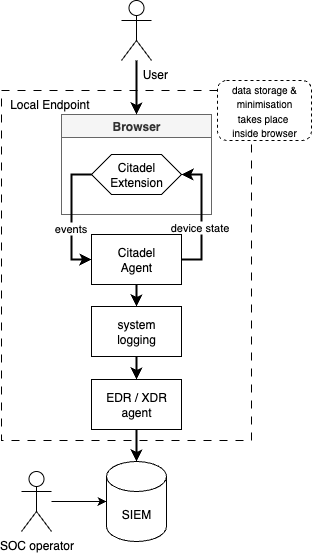
| Process | Detailed Description of the Process | Relevant Data Supports |
|---|---|---|
| Local data collection | Citadel agent collects events and status from browsers and endpoints | Local browser storage, device storage |
| Event reporting | Significant security events for protected systems or urgent security events (e.g. virus, phishing, blocked pages) shipped to SIEM/XDR | SIEM / XDR integration (existing org infrastructure) |
| Data minimization | Storage of only summary / status or non-identifiable data where possible (e.g. hashes, aggregate use); URL, e-mail and secret masking | Local storage, SIEM / XDR |
| User transparency | Real-time dashboard showing which events are transmitted to SIEM | Local agent interface |
| Endpoint control/status checks | Checks for forbidden apps, extensions, security compliance | Only summary control status stored |
2 Fundamental Principles
2.1 Assessment of Measures Ensuring the Proportionality and Necessity of Processing
Explanation and Justification of Purposes
| Purposes | Legitimacy |
|---|---|
| Security event detection, monitoring, prevention | Legitimate interest (GDPR Art. 6(1)(f)): protection of assets and compliance with normative, lawful and contractual frameworks, such as GDPR, ISO 27001, SOC 2, NIS2 and DORA |
| Incident response, forensics (DFIR) | Legitimate interest and legal obligations for post-incident investigation and prevention, as per normative, lawful and contractual frameworks, such as GDPR, ISO 27001, SOC 2, NIS2 and DORA |
| Assurance of control efficacy and compliance | Legitimate interest; necessary to ensure security standards and policies are operating and reducing risk as designed, as per normative, lawful and contractual frameworks, such as GDPR, ISO 27001, SOC 2, NIS2 and DORA |
Explanation and Justification of the Legal Basis
| Lawfulness Criteria | Applicable | Justification |
|---|---|---|
| The data subject has given consent to the processing of their personal data for one or more specific purposes | No | Not relevant—processing relies on legitimate interest of the Company to ensure the security of its information system. |
| Processing is necessary for the performance of a contract | No | Not applicable. |
| Processing is necessary for compliance with a legal obligation to which the controller is subject | Partial | Technical and organization security measures and security incident reporting may be required by law (GDPR, DORA, NIS2…). |
| Processing is necessary to protect the vital interests of the data subject or another natural person | No | Not applicable.. |
| Processing is necessary for the performance of a task carried out in the public interest or in the exercise of official authority | No | Not applicable. |
| Processing is necessary for the purposes of the legitimate interests pursued by the controller or by a third party | Yes | Citadel’s objectives are necessary to protect the organisation’s interests in terms of IT security and compliance with legal requirements and contractual obligations. |
2.2 Legitimate Interest Assessment (shortened version)
Legitimate Interest
The controller has a legitimate interest in protecting its information systems, preventing cybersecurity incidents, detecting malicious activity, preserving the confidentiality, integrity and availability of its systems, complying with legal obligations relating to cybersecurity and protecting personal data processed within its information systems.
Necessity Test
The processing is necessary because cybersecurity incidents cannot be effectively detected solely through traditional preventive security measures such as firewalls or antivirus software.
Security event monitoring, endpoint status verification, browser protection mechanisms and security logging are necessary to detect sophisticated attacks including phishing, credential theft, malware, shadow IT and data exfiltration attempts.
Balancing Test
The impact on individuals is mitigated through numerous safeguards, including:
- local processing whenever possible;
- minimisation of transmitted data;
- masking of sensitive information;
- storage limitation;
- transparency dashboard;
- purpose limitation;
- restricted access to security logs;
- organisational controls preventing inappropriate use of collected information.
Considering these safeguards, the legitimate interests pursued are not overridden by the rights and freedoms of data subjects.
Explanation and Justification of Data Minimization
| Details of Data Processed | Categories | Justification of Need and Relevance of Data | Minimization Measures |
|---|---|---|---|
| Web navigation data (hashed) | Usage | Required for post-incident confirmation | URLs stored only as hashes, local storage only; only shipped to SIEM for protected systems or urgent security events |
| Download/upload metadata | Usage | Investigate / mitigate exfiltration & malware incidents | Metadata only, no file content; only logged for protected systems or urgent security events |
| Application use stats | Usage | Detection of shadow IT, ensure policy effectiveness | Only authenticated sites; only Yes/No indicator transmitted; interaction counts stored locally only to detect minimum usage threshold |
| Control status / info | Endpoint | Detect forbidden software / extensions, compliance | Only summary status saved (not process/file lists) |
| Account security status (password hashes, usage) | Usage | Detect poor password hygiene, identify risk | Only password hash / quality stored locally for protected/insecure accounts; passwords and secrets automatically masked from all logs |
Explanation and Justification of Data Quality
| Data Quality Measures | Justification |
|---|---|
| Agent-initiated periodic refresh | Ensures up-to-date, accurate endpoint and app status |
| SIEM / XDR event reporting | Relies on established SIEM / XDR pipelines for reliable event transport |
| Consistent data structures for event schemas | Ensures analysis and alerts remain accurate |
| Automatic masking of secrets | Prevents accidental logging of sensitive credentials |
Explanation and Justification of Retention Periods
| Types of Data | Retention Period | Justification of Retention Period | Deletion Mechanism at End of Retention |
|---|---|---|---|
| Current data (local storage) | As long as endpoint / agent installed | Needed for ongoing security monitoring | Deleted upon application/user deletion |
| Security events | As per SIEM / XDR policy (generally several months) | Retains logs for compliance, incident investigation | Follows SIEM/XDR deletion or expiration policy |
| Functional traces (local logs) | As above | Needed for troubleshooting, limited scope | Local log rotation or agent uninstall |
Privacy by Design Principles
Citadel has been designed to support cybersecurity operations while minimising the impact on individuals’ privacy.
Accordingly, the solution incorporates the following principles:
- local processing by default whenever possible;
- transmission limited to security-relevant events;
- minimisation of collected and transmitted data;
- automatic masking of passwords, API keys, credit card numbers and other secrets;
- hashing of web navigation information whenever appropriate;
- storage limited to metadata or aggregated indicators where detailed information is not necessary;
- transparency mechanisms allowing users to understand which security events are processed;
- configuration options allowing organisations to adapt the deployment to their own legal and organisational requirement
Assessment of Measures
| Measures Ensuring Proportionality and Necessity | Acceptable / Needs Improvement? | Corrective Measures |
|---|---|---|
| Purposes: determined, explicit and legitimate | Acceptable | |
| Legal basis: lawful processing, prohibition of purpose deviation | Acceptable | |
| Data minimization: adequate, relevant and limited | Acceptable | Periodic review of minimization vs. detection needs; suggestions for improvement welcomed. |
| Data quality: accurate and kept up to date | Acceptable | |
| Retention periods: limited | Acceptable | Alignment with SIEM / XDR data retention policy |
2.3 Assessment of Measures Protecting Data Subjects’ Rights
Determination and Description of Measures for Informing Data Subjects
| Measures for the Right to Information | Implementation Methods | Justification |
|---|---|---|
| Security/privacy notice | Document provided to end-users (“Privacy” tab) | Satisfies GDPR/DP notification duties |
| Notification of monitoring & rights | Document provided to end-users (“Privacy” tab) | Satisfies GDPR/DP notification duties |
| Real-time transparency dashboard | Built-in agent feature showing which events are transmitted to SIEM | Empowers users with immediate visibility into data processing |
| Access to policy documents | Available via internal portal | Ensures understanding/transparency |
| Clear explanations (purpose, categories, rights) | Use of plain English, diagrams for technical docs | User comprehension and confidence |
If third-party data recipients (e.g., SIEM/XDR or incident responders):
| Purpose/Detail | Description in this DPIA & user notices | Transparency/Compliance Info |
|---|---|---|
| Detailed presentation of the purposes of transmission to third parties | Description in this DPIA & user notices | Complies with transparency requirement |
| Detailed presentation of personal data transmitted | Described for each use case/data type | See Data Processing table above |
| Identification of third party companies | SIEM / XDR vendor identified in policy | Provided in organization’s privacy documentation |
Determination and Description of Measures for Obtaining Consent
| Consent Collection Measures | Implementation Methods | Justification |
|---|---|---|
| Consent not collected | N/A | Processing is based on legitimate interest basis; users should in any case be informed |
| Opt-out arrangements if required | Internal IT process | Reserved for exceptional (legal/jurisdictional) requirements |
Determination and Description of Measures for Rights of Access and Portability
| Measures for Right of Access | Internal Data | External Data | Justification |
|---|---|---|---|
| Ability to access all user data via standard IT request | End-user or admin request, documented channel | SIEM/XDR events through established means | Compliance with GDPR access right |
| Transparency dashboard | Real-time view of transmitted events | N/A | Immediate access to processing information |
| Download/archive of user data | By IT upon request | Provided through local admin or SIEM/XDR exports | Ensures portability and user control |
Determination and Description of Measures for Rights of Rectification and Erasure
| Measures for Rights of Rectification and Erasure | Internal Data | External Data | Justification |
|---|---|---|---|
| Rectification (if inaccurate) | Removal / correction via IT admin | Correction on SIEM / XDR if applicable | Ensures accuracy of record |
| Erasure (on request) | User data erased on agent removal or directed erasure request | Event erasure via SIEM/XDR process | Compliance with GDPR “right to be forgotten” |
| Explicit documentation of data retained (e.g., risk logs) | Yes | Technical / system constraints explained | Ensures transparency |
Determination and Description of Measures for Rights to Restrict Processing and Object
| Measures for Rights to Restrict and Object | Internal Data | External Data | Justification |
|---|---|---|---|
| Ability to object to monitoring/reporting | Via IT helpdesk / process | Controls via policy/application uninstall | Ensures user rights, within legal bounds |
| Privacy configuration/deployment options | Defaults outlined in deployment guide | Documented for each installation | |
| Parental / at risk protections | Not directly relevant (enterprise tool) | N/A | Users advised to raise concerns via IT |
Determination and Description of Measures for Subcontracting
| Name of Subprocessor | Purpose | Scope | Contract Reference | Compliance with Art. 28 |
|---|---|---|---|---|
| SIEM / XDR vendor/service provider | Security event storage and management | Only events sent from Citadel | Organization’s SIEM/XDR contract | Yes: must be GDPR compliant |
Determination and Description of Measures for Data Transfer outside the European Union
| Data | France | EU | Country recognized as adequate by the EU | Other country | Justification and Framework |
|---|---|---|---|---|---|
| Security events sent to SIEM/XDR | Possible | Possible | Possible | Possible | Data transfer control is SIEM/XDR policy; if outside EU, clauses / SCCs in place |
Assessment of Measures
| Measures Protecting the Rights of Data Subjects | Acceptable / Needs Improvement? | Corrective Measures |
|---|---|---|
| Information of data subjects | Acceptable | Routinely provide notices and updates; transparency dashboard provides real-time visibility |
| Collection of consent | Acceptable | Not applicable, as processing is on legitimate interest |
| Exercise of access right | Acceptable | Established IT / SIEM request process, regular review; transparency dashboard enhances access |
| Exercise of rectification and erasure rights | Acceptable | As above; periodic review |
| Exercise of restriction and objection rights | Acceptable | Policy for request handling, documentation |
| Subcontracting: identified and contractualized | Acceptable | SIEM/XDR agreements periodically reviewed |
| Transfers outside EU: obligations complied with | Acceptable (if SIEM / XDR contract aligns) | Ensure SCCs or equivalent are used when required |
3 Data Security Risks
3.1 Assessment of Measures
Description & Assessment of Measures Addressing Data Security Risks
| Specific Measures for Data Processing | Implementation Methods or Justification Otherwise | Acceptable / Needs Improvement? | Corrective Measures |
|---|---|---|---|
| Encryption | Local browser and device storage use OS-level encryption if available; SIEM / XDR events protected as per IT encryption policy in transit and at rest | Acceptable | Encourage use of encrypted storage options on endpoints |
| Anonymization | Web navigation data is hashed locally; URL masking: only events for protected systems or urgent security events logged; secret masking: passwords, credit cards, and API keys automatically masked from all logs; sensitive data minimized as much as possible | Acceptable, limited by security needs | Open to suggested improvements |
| Data segregation | Data by default stays on the endpoint except for event transmission; only protected systems and urgent security events logged to server | Acceptable | Periodic audit and confirmation |
| Logical access control | Access to SIEM/XDR event data via IAM; local data protected by OS user profiles | Acceptable | Periodic IAM review, restrict SIEM/XDR access to “need to know” |
| User transparency | Real-time dashboard showing which events are transmitted to SIEM | Acceptable | User feedback incorporated into future improvements |
| Traceability (audit logs) | SIEM / XDR maintains access and event logs | Acceptable | Ensure audit logs are regularly checked |
| Integrity control | SIEM / XDR and local systems apply hash / check mechanisms | Acceptable | Aligned with best practices |
| Archiving | Per SIEM / XDR and organizational data retention policy | Acceptable | |
| Security of paper documents | Not applicable | N/A |
Description & Assessment of General Security Measures
| General System Security Measures Where Processing is Implemented | Implementation Methods or Justification Otherwise | Acceptable / Needs Improvement? | Corrective Measures |
|---|---|---|---|
| Operational security | OS, browser, agent update policies | Acceptable | Regular patching policy |
| Protection against malware | Endpoints covered by org AV policy | Acceptable | Periodic policy check |
| Workstation management | Endpoint management via OS policy (locking, firewall, etc.) | Acceptable | Review at on-boarding / off-boarding stages |
| Website security | N/A (no Citadel backend) | Acceptable | |
| Backups | Data is local / SIEM / XDR, handled via org backup plan | Acceptable | |
| Maintenance | Device runs standard org maintenance | Acceptable | SIEM/XDR arrangements documented |
| Security of IT channels (networks) | Transmission only via secure org channels (TLS/IAM/SCC) | Acceptable | Annual review of transport/encryption |
| Intrusion detection | SIEM/XDR logs monitored by SOC | Acceptable | |
| Monitoring | SOC reviews logs/access | Acceptable | Regular process reviews |
| Physical access control | By org’s physical security policy | Acceptable | |
| Equipment security | Device baseline security per org policy | Acceptable | |
| Risk from location | Handled by org policy | Acceptable | |
| Protection from non-human risks | Handled by organisational policy | Acceptable | Periodic check of DR / BCP, environmental risk mitigation plans |
Description & Assessment of Organizational Measures (Governance)
| Organizational Measures (Governance) | Implementation Methods or Justification Otherwise | Acceptable / Needs Improvement? | Corrective Measures |
|---|---|---|---|
| Organization/Assign roles | CISO / CIO responsible, roles defined in IT policy | Acceptable | Annual review of assignments |
| Policy (management) | Security/data protection policies in place | Acceptable | |
| Risk management | Initial DPIA, periodic review, integration with org risk maps | Acceptable | |
| Project management | Testing done with anonymized/fictive data pre-deployment | Acceptable | |
| Incident / violation management | Documented SIEM / XDR / incident procedures | Acceptable | Test response regularly |
| Staff management | Onboarding/training documented | Acceptable | |
| Third party relations | SIEM/XDR contract reviewed re: access, security controls | Acceptable | |
| Supervision | Policy review, periodic DPIA/data minimization exercises | Acceptable | Annual / major update review |
3.2 Risk Assessment: Potential Privacy Breaches
Risk Analysis and Estimation
| Risk | Main Sources of Risk | Main Threats | Main Potential Impacts | Main Measures Reducing Severity and Likelihood | Severity |
|---|---|---|---|---|---|
| Unauthorized access to data | Insider threat, endpoint compromise, SIEM/XDR misconfig | Unauthorized staff access, exfiltration | Disclosure of sensitive activity, regulatory penalty | Access control, audit trail, SIEM/XDR encryption, URL, e-mail and secret masking, transparency dashboard | Moderate |
| Function creep | Poor governance, training | Staff harassment, illegality | Staff happiness negatively impacted, regulatory penalty | Data limitation by design, URL masking for non-protected systems, transparency dashboard | Low |
| Unintended modification of data | SIEM/XDR config error, agent failure | False alerts, loss of data integrity | Misleading response or investigation | Audit logs, input validation, limited retention | Low |
| Data loss | Device loss, SIEM/XDR failure | Loss of evidence / traces, incident under-reporting | Reduced security, possibly missed incidents | Data backup & retention, centralization via SIEM/XDR | Moderate |
| Insufficient transparency | Transparency features are disabled, configuration changed without notification | Data subjects unaware of monitoring, inability to exercise rights | Loss of trust, regulatory penalty | Use integrated transparency features, communicate changes, employee information/consultation | Moderate |
| Excessive retention | SIEM/XDR storage settings | Data kept beyond necessity, increased exposure window in case of breach | Larger breach impact surface, regulatory penalty | Defined retention schedule, automated purge/archiving, periodic retention-necessity review | Moderate |
| Correlation of logs with other internal datasets | Cross-referencing SIEM/XDR data with HR files, badge/access logs, other IT systems | Unauthorized enrichment/profiling of individuals, re-identification beyond security purpose | Disproportionate profiling, potential discriminatory action, regulatory penalty | Purpose limitation / data silos, restricted correlation rules, approval workflow for cross-system queries, audit trail | Moderate |
| Excessive employee monitoring | Overly broad monitoring scope, absence of proportionality assessment, monitoring beyond security-relevant activity | Surveillance disproportionate to purpose, chilling effect on staff behavior | Staff trust/wellbeing negatively impacted, regulatory penalty | Proportionality assessment, scope limitation to security-relevant events, data minimization by design, employee/work council consultation | Low |
Risk Assessment
| Risks | Acceptable / Needs Improvement? | Corrective Measures | Residual Severity | Residual Likelihood |
|---|---|---|---|---|
| Unauthorized access to data | Acceptable (with proper access controls) | Covered by SIEM / XDR controls. Access to be logged and audited where possible. Enhanced by URL/secret masking and transparency dashboard. | Low | Low |
| Purpose deviation | Acceptable | Training, access restriction, URL masking mechanism, transparency dashboard | Low | Low |
| Unintended modification of data | Acceptable | Covered by SIEM / XDR controls | Low | Low |
| Data loss | Acceptable | Covered by SIEM / XDR controls | Low | Low |
Conclusion
The assessment concludes that the deployment of Citadel may be compatible with applicable data protection legislation provided that:
- the solution is deployed exclusively for cybersecurity purposes;
- appropriate organisational measures are implemented by the controller;
- employees are adequately informed;
- monitoring remains proportionate to the identified cybersecurity risks;
- security logs are not repurposed for incompatible objectives;
- the controller periodically reviews the necessity and proportionality of the processing in light of evolving threats and organisational practices.
Legal Disclaimer This template does not replace the controller’s obligation to conduct and document its own assessment based on the specific characteristics of its deployment.